HD Kumaraswamy accuses Congress of propagating 'misinformation' against VB-G RAM G Act


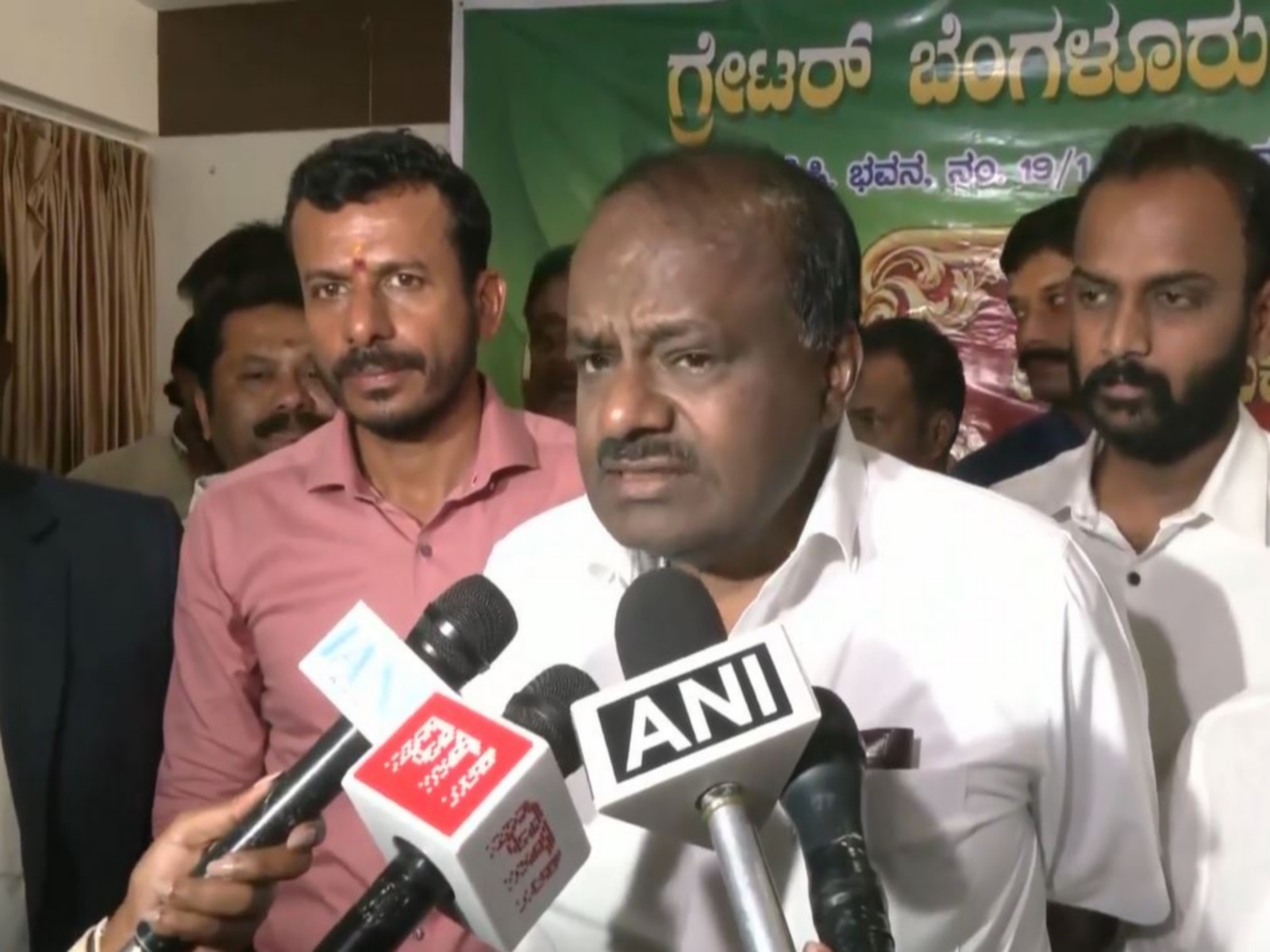
Bengaluru (Karnataka): Union Minister HD Kumaraswamy on Saturday defended the recently cleared Viksit Bharat-Guarantee for Rozgar and Ajeevika Mission (Gramin) (VB-G RAM G) Act, saying that Congress was propagating "misinformation" in the state and country.
Addressing a press conference here, Kumaraswamy said that the Centre's decision to pass VB-G RAM G was crucial. "The Central government has taken an important decision, the VB-G RAM G act has been passed. The Congress is running a major misinformation campaign in the state and nationwide," he said.
He explained that the scheme, originally launched in 2005, has undergone "some changes" and said that the opposition continues to spread misinformation.
"The Congress has been in power for a long time. How many flagship schemes have they named after Mahatma Gandhi? How many of these are in Karnataka, and exactly how many? Yet they continue to spread misinformation," Kumaraswamy said. Kumaraswamy added that the Congress has announced plans to call a legislative assembly session over the VB-G RAM G Bill and intends to undertake a padayatra across assembly constituencies starting January 26. He further rejected the Congress' claim that the scheme is anti-people.
His remarks came after the Congress announced a nationwide three-phase agitation titled "MGNREGA Bachao", after the Centre's newly enacted VB-G RAM G Act.
Earlier, Karnataka Deputy Chief Minister DK Shivakumar on Friday announced that the state will hold a two-day special assembly session to discuss issues related to the Mahatma Gandhi National Rural Employment Guarantee Act (MGNREGA).
The Karnataka government plans to hold a two-day special assembly session to discuss concerns over the impact on rural workers after the Centre replaced the MGNREGA scheme with the new VB G RAM G act.
In December 2025, Parliament passed the Viksit Bharat-Guarantee for Rozgar and Ajeevika Mission (Gramin) Bill, 2025 (VB-G RAM-G) during the Winter Session. The government has proposed Rs 1,51,282 crore to be allocated for the scheme, meant to facilitate employment opportunities and comprehensive development of villages.
The Act guarantees 125 days of wage employment per rural household, up from the existing 100 days, for adult members willing to undertake unskilled manual work.
As per Section 22 of the Act, the fund-sharing pattern between the Central Government and the State Governments will be 60:40, while for the North Eastern States, Himalayan States, and Union Territories (Uttarakhand, Himachal Pradesh, and Jammu and Kashmir), it will be 90:10. Section 6 of the Act allows the state governments to notify in advance, a period aggregating to sixty days in a financial year, covering the peak agricultural seasons of sowing and harvesting.
(ANI)
_MP_Sanjay_Raut_259989_300x172.jpg)


![BJP's Kapil Mishra recreates Shankar Mahadevan’s ‘Breathless’ song to highlight Delhi pollution [WATCH]](https://images.catchnews.com/upload/2022/11/03/kapil-mishra_240884_300x172.png "BJP's Kapil Mishra recreates Shankar Mahadevan’s ‘Breathless’ song to highlight Delhi pollution [WATCH]")
![Anupam Kher shares pictures of his toned body on 67th birthday [MUST SEE]](https://images.catchnews.com/upload/2022/03/07/Anupam_kher_231145_300x172.jpg "Anupam Kher shares pictures of his toned body on 67th birthday [MUST SEE]")


_MP_Sanjay_Raut_259989_1600x1200.jpg "Advocate seeks FIR against Sanjay Raut over social media post on burning of Albania’s Supreme Court")